

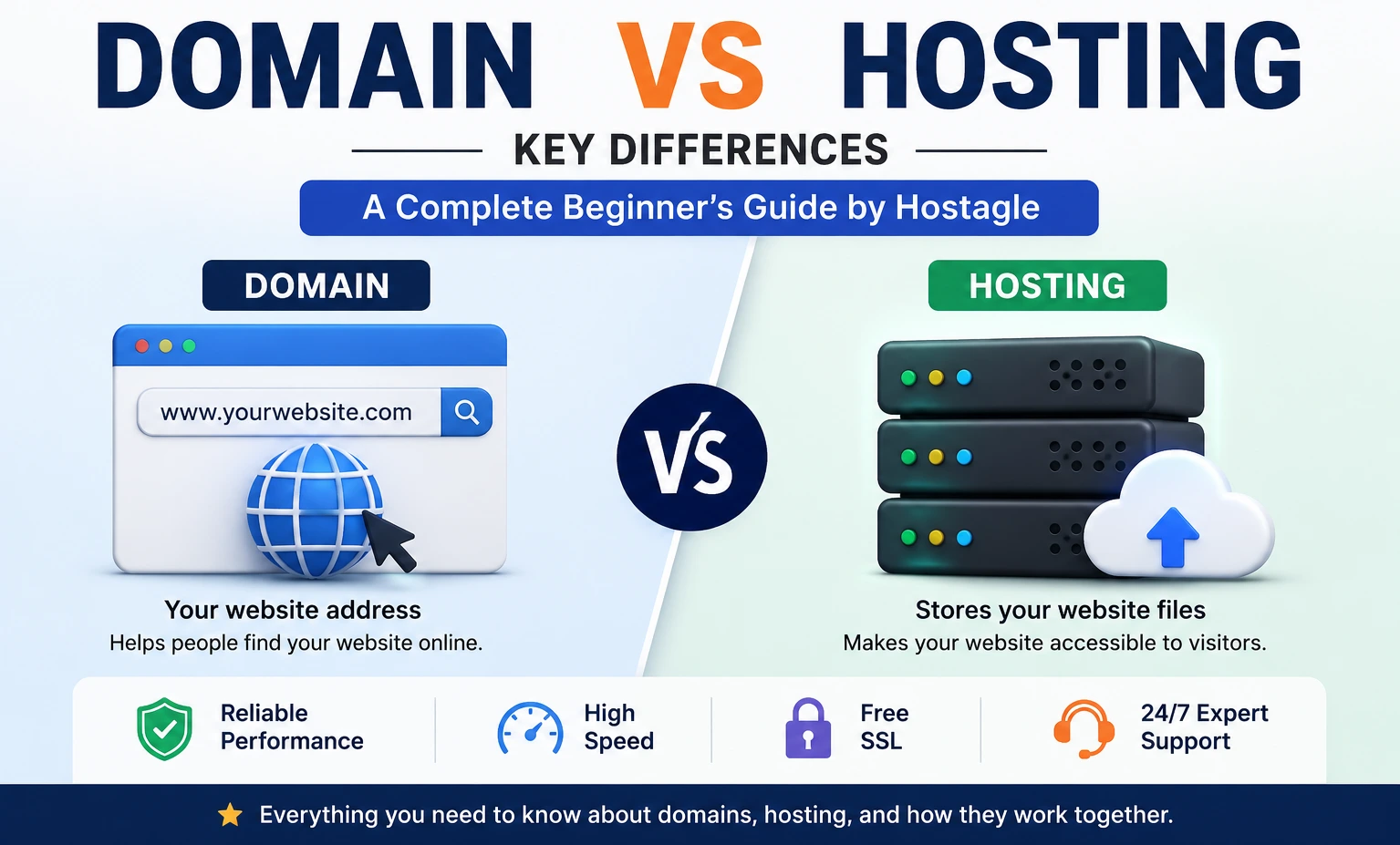
If you’re planning to create a website, you’ll quickly come across two essential terms: domain and hosting. Understanding domain vs hosting is one of the first and most important steps in building a successful website. While both are required to make your website accessible online, they serve completely different purposes.
A domain is the unique name of your website on the internet. It’s what people type into their web browser to visit your site.
Examples of domain names include:
1) google.com
2) amazon.com
3) youtube.com
Without a domain name, users would have to remember a long numerical IP address to access a website, which isn’t practical. A domain makes your website easy to find, remember, and share.
Think of a domain as the address of your house. It tells people where to go, but it isn’t the house itself.
Web hosting is the service that stores all the files that make up your website, including text, images, videos, code, databases, and other content.
A hosting provider stores these files on a powerful computer called a server, which remains connected to the internet 24/7.
Whenever someone visits your website, the server delivers those files to the visitor’s browser, allowing the website to load within seconds.
Without hosting, your website would have nowhere to exist online.
The easiest way to understand domain vs hosting is with a simple real-life example.
Imagine you own a shop.
a) The shop’s address helps customers find your location.
b) The shop building contains all your products.
A simple way to remember it is:
Domain = Address | Hosting = House
Both are essential for building a website.
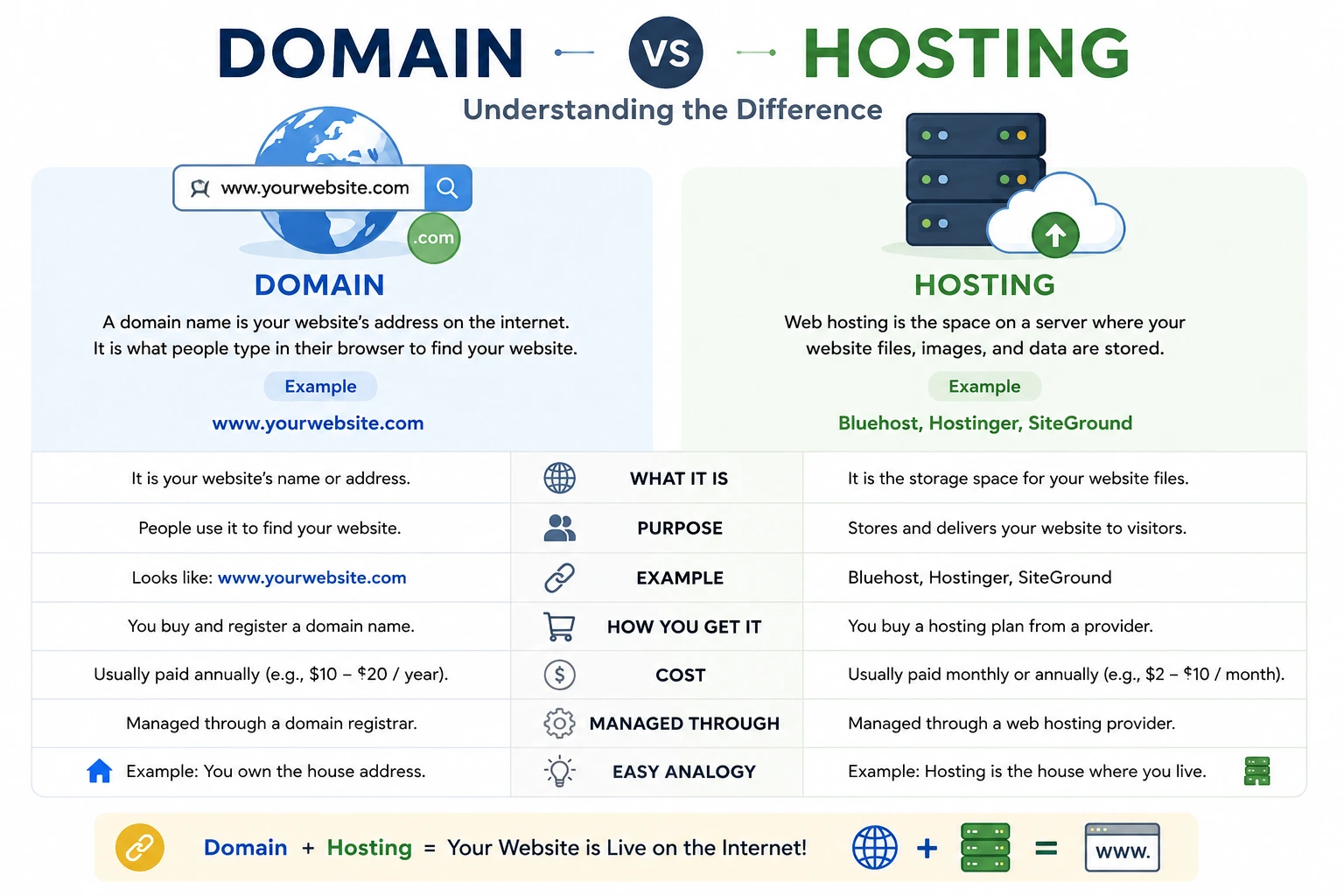
Many beginners wonder whether they need both a domain and hosting.
The answer is yes.
A website requires:
If you only have a domain, visitors can find the address, but there won’t be any website to display.
If you only have hosting, your website files exist, but people won’t have an easy way to access them.
That’s why both services work together.
Here’s what happens when someone visits your website:
Although this process happens behind the scenes, it allows visitors to access your website quickly and seamlessly.
Yes.
Many companies allow you to purchase a domain name and web hosting separately. You can buy them from different providers and connect them later by updating your DNS or nameserver settings.
However, beginners often prefer purchasing both from the same provider because it simplifies setup and ongoing management.
Choosing the right hosting plan depends on your website’s size, traffic, and future growth.
Shared hosting is the most affordable option, where multiple websites share the same server resources.
Best for: Personal blogs, Portfolio websites, Small business websites, Beginners
Virtual Private Server (VPS) hosting provides dedicated resources within a shared server, offering better speed, security, and performance.
Best for: Growing websites, Medium-sized businesses, Developers
Cloud hosting uses multiple servers instead of a single one, improving reliability, scalability, and uptime.
Best for: High-traffic websites, eCommerce stores, Business websites
As your website grows, you may need a more powerful hosting plan.
Common signs include:
Upgrading your hosting helps maintain speed, security, and a better user experience.
When learning about domain vs hosting, many beginners make these common mistakes.
Choosing Only Based on Price: The cheapest option isn’t always the best. Low-quality hosting can lead to slow website speeds and frequent downtime.
Ignoring Customer Support: Reliable customer support is essential when technical issues arise.
Buying an Expensive Plan Too Early: New websites rarely need advanced hosting plans. A quality shared hosting plan is usually enough to get started.
Forgetting Renewals: Both domain names and hosting plans require periodic renewal. Missing a renewal can temporarily take your website offline.
If you’ve already chosen your website name, it’s a good idea to register your domain first.
Popular domain names are often purchased quickly, so securing your preferred name early can prevent disappointment.
After that, select a hosting plan that matches your website’s needs and budget.
For most beginners, a shared hosting plan offers the perfect balance between affordability and performance.
When comparing hosting providers, look for these important features:
Choosing the right provider from the beginning can save you time, money, and future technical issues. For example, Hostagle offers high-performance LiteSpeed servers for faster loading speeds, strong security, reliable uptime, and user-friendly tools, making it a great choice for beginners and growing websites.
Understanding domain vs hosting is one of the first and most important steps in building a website. A domain name acts as your website’s online address, while web hosting stores all the files and content that visitors access.
Remember this simple formula:
Domain = Address
Hosting = House
Both services work together to make your website accessible on the internet. By choosing the right domain name and a reliable hosting provider, you’ll build a strong foundation for launching and growing your website with confidence.
Whether you’re starting a personal blog, a business website, or an online store, understanding the difference between domain and hosting will help you make informed decisions and avoid common beginner mistakes.
If you’re ready to launch your website, Hostagle offers reliable domain registration, high-performance web hosting, free SSL certificates, easy website management, and dedicated customer support to help you get online with confidence. Explore Hostagle’s hosting solutions and choose a plan that best fits your website’s needs.
Yes. You can register a domain name without purchasing hosting. However, your website won’t be visible online until it’s connected to a hosting server.
Yes. You can migrate your website to another hosting provider while keeping the same domain name.
Some hosting providers offer a free domain name for the first year, while others require you to purchase it separately. Always check what’s included in your plan.
Both are equally important. A domain helps visitors find your website, while hosting stores all the files that make your website accessible online.
Yes. Many hosting plans allow you to host multiple websites using different domain names, depending on your hosting package.